Showing posts with label stats. Show all posts

Jan 10, 2019

A Year of Reading in Review, Vol 4

This is my fourth year of writing up a yearly reading review. In time, that's about equal (more or less) to a college education. I'm not convinced that I've lived up to that in the past, but future reading trends are pointing a more scholarly direction. You can see a type of specialization happening in my reading from this year already -- when I find something I like I really dig down into it.

There were several of these types of 'marathons' this year. Previous years have definitely had themes to them, no doubt about that, but this year's felt particularly interest driven. Michael Lewis and Hannah Arendt are the two biggest carry-overs from 2017, so I definitely 'completed' the goal of reading more of them in 2018. To date, I think I've read almost every book Lewis has published. I'm probably about halfway through Arendt's works. I've got one of her books on the docket for 2019 but I'm not very optimistic about getting through it. My interests for 2019 are taking a bigger role in dictating what I'm prioritizing reading, and I don't think that Arendt quite makes the cut.

Stats

I try to keep track of the books that I read in Goodreads. One because it makes it easy to sort and two because they do a nice year end summary of total pages and book counts. I still have to compile publication dates by hand, though. Here's hoping they add that as an easy metric to track at some point in the nearish future. 

I hate to say it but I think I'm going to be extra lazy this year and not put together a 'when was it written' histogram. As much as I love knowing the stats, I'm not feeling particularly up to it at the moment. I might come back and update this later, but probably not.

According to what I've remembered to enter into Goodreads, I either finished (or decided not to finish) 50 books last year, for a total of 15,006 pages. Compared to last year that's almost twice the number of books, but only 5,000 pages (33%) more.

Errata

For what it's worth, 2018 felt like the year that reading hard books got a lot easier. Hannah Arendt's Origins of Totalitarianism in some weird, unfathomable way, marked a big turning point in my personal ability to read 'difficult' works. I mean, I've read a lot of technical, not so easy things over the past decade or so, but something about the subject matter and just Hannah's insightful way of writing feels like it changed the game in terms of both what kinds of work I find myself able to enjoy and my bar for what good writing should read like.

In addition to moar reading, I also did lots more writing in the second half of 2018. Both on this blog as well as my two other media properties, plus Twitter. I also was an 'official' editor for the first time ever in 2018, for The Prepared. I edited the piece they just published on supply chains in Africa.

I also got into reading technical papers and books, more so than any previous year. As with previous years, I spent a lot of time on Twitter -- I probably spent hundreds of hours reading and replying to threads. I wonder how many books that reading time would have translated into. This next week I'm going to try picking up a book in the morning instead of my phone, to see how much farther through my stack I get.

And boy howdy do I have quite the stack right now. 2018 was a big year for book buying. I read a small fraction of the books that I acquired, and I'm looking forward to lots of great reading in 2019. To be honest, this year-end review is a huge motivator for getting through the books I've got piled up, a bit like looking forward to adding them to my killsheet. If we're being honest, if I stopped buying books today (and trashed my library card) I would, hands down, have enough books to get me through 2019.  Is finishing books the point? Yes definitely, because each book represents a specific skill or interest that I'd like to acquire. I'm a very greedy person, in that regard.

As you're wont to do in your senior year, I've finally hit upon a writing project that is going to require a good amount of reading investigation. I expect this coming year to be filled with books that help support my latest academic interest: quantum rhetoric (you can follow along with my reports back on the project's blog: http://foolproof.ink/).

Reviews + Top Picks

Alright, enough exposition. Here's my top picks.

Top Picks

The Intelligent Investor by Benjamin Graham. Classic on investing and stocks.
Debt: The First 5000 Years, David Graeber. What is money, really?
The Origins of Totalitarianism, Hannah Arendt. Great fucking book on where political movements come from, specifically authoritarian ones.

My top picks are all about explanation: political and economical and marketable. See below for a bit more info on these, and every(?) other book I read in 2018.

Hot Takes

The Question Concerning Technology Martin Heidegger, translated by William Lovitt
7/10

First off, fuck William Lovitt. As far as I can tell, his is the only translation of Heidegger's essay "The Question Concerning..." in English and it sucks. It is hot, over done trash. It reads like a graduate student's project. I mean yes, I am grateful that he spent the time to translate it because the essay is really phenomenal but I cannot, unfortunately, recommend the translation. It's on my 'todo' list to put out a translation of the translation -- i.e. something actually readable, because the essay deserves it. Sort of.

If you can get past the terrible translation, this essay is marvelous and brilliant and thought provoking and Heidegger is a fucking trolling turkey and I love him for it. Written around the time of the nuclear bomb, Heidegger attempts to situate human's relationship with technology in terms of our general 'nature'. It's an absolutely stunning piece, one that comments deeply on the often talked about relationship between technology and the humanities or arts.


Trouble in Paradise, Slavoj Zizek
-/10

I didn't finish this, as I just couldn't get interested in it. Maybe someday, in the distant future. Maybe someday, in a different reality.


The Soul of An Octopus, Sy Montgomery
-/10

Yet another book I tried and failed to read. This book fit a writing style or pattern that I seem to be struggling to engage with lately. It's a personal memoir with science-y anecdotes thrown in, more portrait than prose or narrative. Or maybe not, I honestly just couldn't get into it. I wanted more of a contemplation on consciousness, but this book wasn't it.


The Economic Naturalist, Robert Frank
2/10

The intro to this book alone is far higher than 2/10 but the rest of the book is incredibly not worth reading. It's mostly a compilation of questions about why the world is the way it is, that's attempted to answer via an 'economic' mindset. Entertaining, sort of but it got old really quickly.


Jane Jacobs: The Last Interview and Other Conversations, Jane Jacobs
4/10

I've concluded that I've read almost all I can by Jane Jacobs that would be new information. This book, sadly, only reinforced that idea. It's got some great interviews with her, but none of them were really new to me. Ce la vie, eh?


Making Things Move, Dustyn Roberts
8/10

Oh my goodness this book was absolutely amazing. It's more of a how to for electronics projects, but as someone who knows not very much about circuits or power or how motors work, this book was the perfect introduction. I now own a benchtop power supply because of it and feel 100% more confident in my ability to get motors and other electronic projects up and going. I highly highly recommend this book to anyone who's circuit or electronic project curious.

Worth noting that Dustyn was a professor at ITP, an amazing graduate arts / technology program at NYU.


The Bone Season, Samantha Shannon
The Mime Order,
The Song Rising,
The Pale Dreamer.
6/10

Fantasy series from a British author. Good, light reading about a dystopic London filled with magic and shadowy death creatures. I read them while hiking through Portugal on vacation and while I can't recommend them for a hiking backpack (they're a bit voluminous), they're great fun escapism. I'm looking forward to her next 'standalone', The Priory of the Orange Tree


Mastering Bitcoin, Andreas Antonopoulos
8/10

This book really changed the career game for me this year. I read it in March/April when I started a new job working on a Bitcoin custodial wallet, and I immediately fell in love with Bitcoin. The book is a great primer on the topic from a technical angle, but is a bit far behind now in terms of SegWit and Lightning. If you're looking for a nuts and bolts explanation of how Bitcoin the protocol works, you could do far worse. I even talked my mom into reading this one. She was suitably not impressed.


Flash Boys, Michael Lewis
8/10

This book really opened my eyes to the realities of modern stock market trading and dark pools and front running, and weirdly enough, convinced me that stock trading isn't nearly as complicated as the jargon makes it out to be. Caveat emptor: You may not have the same thought reading this book.  It's the story of a man named Brad Katsayuma and his quest to build a stock exchange that looks after the interests of its investors, not the hedge fund traders looking to bank in on having a technical edge -- one that lets them cash in on microsecond long information asymmetries.  If you're at all interested in how modern money markets work, this book is a must read.


The Big Short, Michael Lewis
7/10

I read a lot of Michael Lewis this year. Because his books are great -- every single one of them. This book tells the story of the financial crash of 2008. I took a couple things away from this story. The first is that willingness to dig in and just read the information that's public and out there sets you apart from 95% of anyone in a field. At least, used to. The other is that even money is political. Spoliers coming but: I can't remember the character's name, but the weird med student turned hedge fund trader that sets up shop in California, makes a big bet on the subprime market collapsing, cashes in big, and then gets abandoned by all of his big investors because of the tactics he pulled to make sure that the bet came off ok. Trust is important, no matter what field you work in.


Binti, Binti:Home, Binti: Night Masquerade Nnedi Okorafor
6/10

One of the few sci-fi series I read last year. I really enjoyed getting into some shorter fiction. They didn't quite hit my system construction buttons as much as I would have liked, but I think that was a function of length. Short synopsis is about a woman who leaves her small town backwater for space university.


The Tompson Method of Bodywork, Cathy Thompson
8/10

My voice teacher recommended this book to me for the vocal exercises in it. I'd never heard of bodywork, but this book is revolutionary in it's wholistic look at emotions and aches. I've long believed that emotions and mindstate is heavily influenced by our bodies -- that the mind/body connection is more connected than the little slash between the two words would have you believe (mind is a construct that originates in the body and all that). This is an incredibly practical book full of low key stretching exercises to help you sort out and find apparent and latent pain. I'm terrible at doing body maintenance things regularly, but this book helped me work through some excrutiating back and arm pain earlier this year. Desk work sucks!


Men Explain Things To Me, Rebecca Solnit
4/10

In a lot of ways, this book helped sparked a movement called `mansplaining`. I'm sure it's good, but I don't remember it so I'm giving it low marks. These sorts of tracts are ones I always have trouble holding in my head, which imo is never a great sign for the writing or topic.


Eichmann in Jerusalem, Hannah Arendt
9/10

Forget fucking Anne Frank's diary. This is the book that we should be making high school children read when we teach the fucking Holocaust. Arendt attended the trial of a Nazi party wonk in Jerusalem and wrote back court reports for an American magazine. This book is the compilation of those reports. This is easily one of Arendt's most accessible books, and it's brilliant and scathing and so incredibly damning. It was hugely controversial in the Jewish community when she released it, mostly for how it told the real story of how Jewish communities in Europe inadvertently helped keep the gas stoves full. All in all, this is a world class portrait of bureaucracy and personal responsibility -- issues that are more modern now than ever.


Boomerang, Michael Lewis
7/10

I read a lot of Michael Lewis this year. I think this one is the one where he goes around to all the countries that got fried by the 2008 financial crash and reports back what the aftermath of the meltdown has been. Destinations include: Greece, Germany, Iceland, and Vallejo, CA.  This kind of detail on a financial crisis is what makes Lewis such a great, and reliable story teller. His stuff is good because he does the on the scenes reporting, talking to the characters that no one else seems to think to ask about.


Reconsidering Jane Jacobs, Max Page
2/10

Another one I don't really remember the content of. I picked this up a while back when I was looking to get a better understanding of what critical work had been put out in response to Jane Jacobs' theories about economies. The short answer is not much. This book has some rebuttals but none of them were particularly coherent or salient.


The Origins of Totalitarianism, Hannah Arendt
10/10

Out of all the books I read in 2018, this is one of the ones that I'm the most proud of having finished. It was a real job to get through it, as the prose is incredibly dense. Dense, but so rich. The level and clarity of Arendt's insights into how human political bodies think and the history of their motivations is unparalleled. This work is a classic, and speaks so soundly to our modern era. I truly think that Arendt will prove to be the philosopher of our modern times. It really upsets me that she's not as widely read as other, more ancient philosophers like fucking Descartes or Plato or Nietzsche or fucking Marx. Like fuck Marx. He doesn't have nearly as much relevant shit to say as Arendt fit into this one book.  Briefly, Origins covers three large social trends in Europe from the late 1800's up until the 1940's: Anti-Semitism, Imperialism, and Authoritarianism. Part history lesson, part philosophy, part sociology, Arendt explores the events and motivations for human action that contributed to the rise of the Nazi party in Germany and the Bolsheviks in Russia. Meticulously researched, if I let her, she'd have filled up my reading list for the rest of the year with original sources. I did buy Democracy in America on her recommendation, and am looking forward to getting into it in 2019.


Networks of New York, Ingrid Burrington
3/10

This book is more like a who's who of network paraphernalia and ISP providers in New York City than the indepth look at computer networking that I was hoping for. It's well researched and the pictures are quite good. I rather liked learning about the companies behind all of the city's connectivity but my initial disappointment at wanting a book on 'networking' rather than equipment and companies is why it's rated so low.


Aw yeah here it comes. The great Lewis run. Ready?

Panic!, Michael Lewis
9/10

This book is a compilation of news articles and clippings surrounding the last four biggest stock market crashes that we've had, internationally as well as in the USA. The goal of this book seemed to be to show us how incredibly nothing that we as humans know and understand about financial crashes; both that no one can predict them and that they're devastating. The article format didn't make it the smoothest in terms of narrative, but it did change the way that I think about investing and crashes and that's been incredibly valuable in the last few months.


The Money Culture, Michael Lewis
6/10

Compilation of articles Lewis wrote while he was working at an i-bank in NYC in the 80's. Great look at the mentality of men who trade money for a living. A bit dislocated because of the article nature of it.


Home Game, Michael Lewis
7/10

Journalistic recounting of the joys and pains of fatherhood. Great short read.


The New New Thing, Michael Lewis
8/10

Profile of Silicon Valley told through the lens of the story of the man who made a zillion dollars at least twice during the first dot com boom (Silicon Graphics and Netscape): Jim Clark. In some big way, Clark was responsible for a lot of the way investors approach Silicon Valley. At least, according to this book he is. Most of this book focused on the huge side project Clark worked on during most of his time during the period that he was supposedly starting big new projects -- a self-sailing sailboat called Hyperion. (Which incidentally is now up for sale.)


next, Michael Lewis
9/10

I loved this one. It's a short series of profiles of people who's lives have massively changed by the Internet, way back in the 90's. It reads incredibly fresh and relevant, even 20 years later. I'm continually amazed at how Michael is able to pick up on interesting trends and movements in society and then find interesting stories to showcase them. Ace job on this one, imo.


Losers, Michael Lewis
8/10

This one's interesting to me, because it doesn't really readily appear on most collections of Lewis's work. I think I found it on Wikipedia, or another book's list of 'other works by'. It's basically a behind the scenes tour from the 1994 campaign trail, from the Republican field as they work towards knocking Bill Clinton off of the pedestal. Ultimately a failure, but it's again fascinating to see how certain, um, trends in the Republican platform have been around for pretty much forever at this point.


Pacific Rift, Michael Lewis
7/10

A look at Japanese business and money culture, from Lewis's time working in the financial industry in the 80's.


Coach, Michael Lewis
7/10

Short book telling the story of Michael's high school ball coach, that's also a meditation on growing up, personal responsibility, and the role of parents in their children's lives these days.


The Undoing Project, Michael Lewis
8/10

I really didn't want to read this book, as I thought the reviews of it weren't that interesting (two economists that work together, who cares?). I was wrong. As usual, Lewis found a great story to tell, this time of two Israeli economists who spent a lot of their time re-evaluating how human emotion and biases impact our actions and judgments. This feels, in a lot of ways, like a furtherance of the themes on bias and numbers that Lewis started with Moneyball.


The Blind Side, Michael Lewis
8/10

Absolutely a great story about how the game dynamics of football changed the value of a particular position, and the rise of one particular low-income boy who just so happened to be the perfect build for that particular, now well valued, position.


The Fifth Risk, Michael Lewis
8/10

Recently, Lewis has been working to understand what kind of an impact the coming Trump presidency will have on bureaucracy in America. For this one, Lewis went around and interviewed a bunch of people that worked on the Trump presidential transition as well as long time bureaucrats who left office with the regime change. Fucking terrifying in its conclusions with regards to project management expertise and the current administration.


Debt: The First 5000 Years, David Graeber
10/10

Graeber's one of those writers to watch. If I had a million hours, I'd definitely go back and read everything he's written. Which is a hell of a lot, to be honest. In Debt, he digs into the history of money. Where did it come from? I really enjoyed the anthropological view that he took on money. This book definitely changed the way that I think about both commerce and Plato's theory of forms. It also led me to some particularly interesting insights into Bitcoin, which you can check out in this basicbitch post.


Thinking in Bets, Annie Duke
-/10

I didn't finish this because I couldn't stand the narrator. I'd classify this as an overhyped business book. It might have some gems of wisdom in them, but I'm not about to torture myself to get them. Ostensibly about Duke's experience winning poker hands.


The Intelligent Investor, Benjamin Graham
10/10

This book is a bit slow going, but really great. If you get it, get the updated copy with commentary from Jason Zweig -- some of the regulation and availability of different securities has changed in the last 60 plus years.  Graham 'invented' the concept of value investing, which basically means buying stocks that are worth the money. He also goes into how bonds work, and various different types of investments. I learned a lot and it's really made picking stocks out a bit more fun than it was before. If I was actually taking his advice though, I'd buy index funds. I might try to set this up for 2018.


Revolution at Point Zero: Housework, Reproduction and Feminist Struggle, Silvia Federici
9/10

Collection of essays and articles by feminist Federici. This is one of the most coherent takes I've seen on the chronic undervalue of women's labor -- both at work and in the home. Federici argues that we should be paying women a wage for housework and I couldn't agree more. Between this book and Graeber's Debt, I think I've got a pretty good case for the masculinity of money.


Distributed Systems, van Steen and Tannenbaum
7/10

I wanted to take a course on distributed systems, but couldn't make it work with my schedule so instead I read the textbook. That was this one. I managed to get through it in a week, which was no small feat but holy cow did reading this book change the game for me in terms of understanding both Bitcoin and modern problems in computing. I'm not sure I'd totally recommend it though, since the writing style is more case study like than explanative. That being said, it's really clear that the authors know their stuff -- I really appreciated their ability to understand and sort convey the importance behind a bunch of key work in distributed systems.


The C Programming Language, Kernighan and Ritchie
9/10

This book is about the C programming language. It's good for people that are new to the language. I really enjoyed the tone that this book was written in and found the exercises incredibly helpful. It's short, to the point, and does a great job of pointing out the nuances of the language in an easy to understand way.


The GNU Make Book, John Graham-Cunningham
5/10

Just ok, I think. I picked this up because I don't really understand Make. I understand it a bit better now. This book did a good job of talking through some of the more advanced usages of the make system, but I didn't love it.


Illusions: The Adventures of a Reluctant Messiah, Richard Bach
6/10

A short book slash parable about what it'd be like to be god. Pretty good if you're into new age philosophical works.


Kingpin: How One Hacker Took Over the Billion-Dollar Cybercrime Underground, Kevin Poulsen
8/10

It feels like I read a bunch of books about early Silicon Valley this year. This is one about a hacker named Max Butler who gets into the stolen credit card game, what was easily the biggest 'digital money' available for stealing on the Internet, at least until Bitcoin. It was interesting to read about the Hungry Hackers gang -- it seems like a good number of them still live in the Bay Area.


Prometheus Rising, Robert Anton Wilson
6/10

I picked this book up because it teased something about quantum mind states. It turned out to be another new age philosophy slash metaphysics books. It goes through the levels of consciousness and awareness, consolidating thought from  Freudian, yogic, tarot practices, to name a few.  Thought provoking and a quick read, I learned a lot about tarot from it.


The Hitchhiker's Guide to the Galaxy, Douglas Adams
9/10

Great book by an amazing comic. I was, in some way, struck by how similarly the Adams' prose mimics some short stories I've written in the past. It was eerie to realize that other people had a similar style. About the book: adventure story about getting blasted around the galaxy with a man who's a professional intergalactic hitchhiker. I was really shocked by how close this book gets to discovering quantum rhetoric on its own.


How to Change Your Mind, Michael Pollan
7/10

Both a history and personal recounting of psychedelic research in America. Based on the broad conclusions of this book, I would love to see psychadelics both decriminalized as well as institutionalized in terms of being an easily available form of treatment for depression and addiction.


My Year of Rest and Relaxation, Ottessa Moshfegh
5/10

Depressing fucking book about what happens if you disappear from your life with the help of a bunch of prescription pain pills. Sort of a great portrait of what a disconnected, disappearing life in New York City is like. I really like reading books based in NYC, so this one was super fun for that.




Jan 10, 2018

A Year of Reading in Review, Vol. 3

It's time for the annual year of reading review.  There's a number of books on the list this year that really deserve a longer blurb than I'm going to give here. Hopefully this year I'll do a better job of actually writing in depth reviews of books I've read.

On the face of it, I read far less books this year than in the past two years.  In 2016 I read 52 books, roughly one book per week. This year I reported reading just over half that many, 29.  There's a few reasons for this discrepancy. The first is that I simply read less books.

Secondly, in 2016 I counted books that I decided not to read.  I did this because "deciding not to" was a theme of 2016 and I wanted to celebrate the books that I chose to put aside.  I took several books off of my reading list in 2017, but it felt so natural it doesn't seem worth counting.

According to Goodreads, these 29 books contained 10,289 pages. The oldest book was Eric Hoffer's True Believers; the newest, Phillip Pullman's first installment of his new Book of Dust series, was published in Octobe of 2017.  Believe it or not 3 of the books that I read were published in 2017.  Talk about quick turn around time!

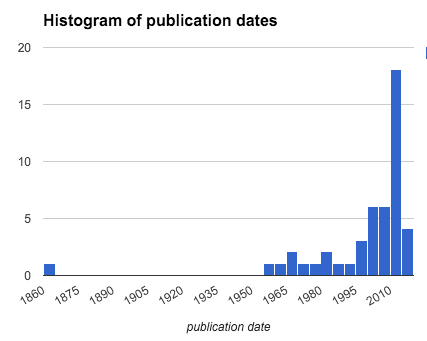
Looking at the histogram of when the books I read were published, I feel that I did a pretty good job of reading a mix of older books while keeping up on new works.

On a whole, I feel like the quality of the books I read this year was higher than last year's. I really enjoyed the majority of the books that I read in 2017, and found a few new favorite authors!


Authors I'd Love to Read More of in 2018

Hannah Arendt.  Hannah's writing and clarity of insight is boss level good. Her book The Human Condition is, at least on Wikipedia, quoted as being one of the best books of the 21st century.  I do not think that they are exaggerating. In terms of depth and quality of analysis of real world phenomena, I'd put her on par with if not better than Jane Jacobs.  I'm really looking forward to reading more of her work in 2018, particularly Eichmann in Jerusalem.

Michael Lewis. Lewis is a master storyteller.  His books paint the most vivid pictures of the people involved, in a really concise and clear way.  He does such a great job of contextualizing everything; it's really inspiring. If I could write like anyone, I would want to write like Lewis does.  I wasn't expecting to enjoy his books as much as I did.


Themes

Stories about the way the world works, the people that work inside of it; books that inquired into the nature of human work and trade and thought; I tried out a few new fiction series, none of them really stuck. I read my first ever Chinese fiction and realized what an enormous super power Asia will be for the 21st century.  I read books about urban structures and power systems within them.  I learned a lot about the specific history of some niche industries and phenomena.


Top Picks

Usually my top picks for books are the ones that contain vital human truths that everyone must know.  This year's a bit different -- instead I picked books that I really enjoyed reading.  Vital truths aren't always the most enjoyable!

The Human Condition, Hannah Arendt
Crazy Rich Asians, Kevin Kwan
Fortune's Formula, William Poundstone

Book Synopses / Hot Takes

Stories of Your Life and Others, Ted Chiang
6/10

This is a collection of short works of speculative fiction.  I found the central conceit of the stories to be incredibly good, but the actual prosic execution lacking in spark.  More than anything, the tone and pacing of the stories didn't feel very natural.  Worth reading for the brilliant story lines alone, however.

Creativity, Flow and the Psychology of Discovery and Invention, Mihaly Csikszentmihalyi
2/10

I'm rating this book low because I found it lacking in rigor and insight; the writing was just plain boring.  However!  Csikszentmihalyi attempts to find commonalities between people that he terms Creatives with a capital C -- the difference being that a Creative has an impact on a community; whereas a normal creative doesn't necessarily build a practice around their work.  Another thing that Csikszentmihallyi points out, but without much extrapolation or further exploration, is that most of the individuals his team marked out as 'Creative' lost one or both parents at an early age.  I personally can't stop thinking about this; in particular what does it say about the parent child relationship? How has a rising age limit on people changed our ability to build independence; what is the relationship then between independence and creativity?  These questions are not addressed in this book, but I find them incredibly relevant; our politicians are on average older than ever.  On a personal note, all of my grandparents and parents are still alive (and I just turned 30!).  Is it normal for humans to live for 30 years without a close personal loss?  Has this affected my own independence/creativity?  Hard to say.

The Princess Diarist, Carrie Fisher
5/10

This is the tell-all novel of Fisher's 3 month affair with co-star Harrison Ford during the filming of the first Star Wars film.  This book convinced me that Star Wars owes its success to both George Lucas's genius and Carrie Fisher's wonderful love for life.  Fisher passed in Dec 2016; I'm glad she got this book out before she went.

A Manual For Cleaning Women, Lucia Berlin
3/10

In isolation, I think Lucia Berlin writes amazing stories.  As a collection of work, however, the themes and situations that her characters find themselves in struck me as incredibly repetitive. Make no mistake, Berlin is a masterful storyteller, but I got burnt out.

Fortune's Formula: The Untold Story of the Scientific Betting System That Beat the Casinos and Wall Street, William Poundstone
9/10

I love books that tell stories about people in real life, while teaching you something about the world. This book does that; it clearly shows how the Martingale betting strategy works while telling the story of the men who created and refined it.  I know considerably more about the world of bet making now, with the historical context to understand it.  So good.

City of Quartz: Excavating the Future in Los Angeles, Mike Davis
7/10

This book is weird. It doesn't really fit into any category outside of a certain genre of woke literature. It tells the history of L.A. through various aspects of the city's geography. It's incredibly good and also incredibly dense; it took me forever to read this book. More than anything, I blame this book for slowing down my reading progress in 2017.  Definitely worth a read if you're interested in urban spaces and the political power of space.  Also, being new to California, it was an AMAZING primer into the history of land use and speculation in Cali, and more than anything really drove home why the rent is so goddamn expensive here.  History matters yo!

La frantumaglia, Elena Ferrante
6/10

This English translation of Elena Ferrante's was released in Oct 2016; I didn't get around to reading it until early 2017.  I was absolutely floored by Ferrant'es Neopolitano series; Frantumaglia is a collection of Ferrante's letters writing about her writing process, her relationship to her readers, and some further context for the inspiration for her work.  Ferrante is well-known for her secretiveness -- Elena Ferrante is in fact a pseudonym; no one knows for certain who the actual author is.  I enjoyed reading her personal correspondences and interviews but eventually found them to be a bit repetitive.

Liar's Poker, Michael Lewis
9/10

This is such a good book. Lewis is a masterful storyteller.  In Liar's Poker, he walks us through the politics and personalities of the Salomon Brother's trading firm in the 80's, when the mortgage credit derivative desks were getting their start.  It's a must read for anyone who wants to better understand how trading desks actually work, and why the Sarbanes Oxley act was so incredibly necessary.  More than anything, this outlines the history of mortgage backed securities, more or less foreshadowing the crash of '08.

The Geography of Nowhere: The Rise and Decline of America's Man-Made Landscape, James Howard Kunstler
-/10

This is embarrassing. I honestly don't remember much about this book.  I think I read it too close in time to Organization Man; they both largely trace the same phenomenon but through different lenses.  Org Man focuses very acutely on a single neighborhood and the psychology of large organizations; Geography of Nowhere focuses more on the built environment and the impact of a car based culture.  Good but apparently not incredibly memorable.

Milk and Honey, Rupi Kaur
6/10

A collection of very personal poems. A good, quick read.  Honestly I think I would have enjoyed these a lot more had I read them 6 years ago.

The Organization Man, William Whyte
8/10

I found out about Whyte's book through a biography of Jane Jacobs; I believe that Whyte was an editor or peer of Jane at the Architectural Forum, but don't quote me on this.  I loved the close, psychological profile that Whyte paints of the type of individual that does well in corporate environments. In a large way, it echoed the guardian syndrome that Jane spells out in Systems of Survival.  His comparison of organization men to socialist societies is A+; as well as his in depth dive into the communal aspects of early suburban living.  My favorite thing about this book is the appendix where he tells you how to beat personality tests that are given to you by corporations. It would have come in handy back in high school -- I failed the first one I ever took, for a job working as a cashier at a suburban grocery store chain.

 Why I Am Not a Feminist: A Feminist Manifesto, Jessa Crispin
2/10

All I remember from this book is thinking how terribly written it was.  It was one of two books published in 2017 that I read and is a stark reminder of why Nicholas Nassim Taleb recommends reading older books as they've mostly already been weeded out for you.  While it might have had good points based on my recollection of the terrible writing, I don't recommend this book.

The Existential Pleasures of Engineering, Samuel Florman
7/10

This book is an older but incredibly relevant collection of essays and thoughts on the ethical responsibility of engineers and the communities that engineers work in.  He's got a great, early essay in the appendix on why getting more women into technical careers is important for the robustness of engineering solutions and the societal impact of engineering innovations.

Moneyball: The Art of Winning an Unfair Game, Michael Lewis
8/10

When Moneyball came out, I was an undergrad at the McCombs School of Business at the University of Texas at Austin.  A lot of my professors and fellow classmates were incredibly enamored with this book; for that reason alone I stayed away from it. That was a mistake. This book is pure bloody genius. If anything, its a great story of how the commerce mindset disrupts a traditionally guardian industry of picking ball players.  I'm glad Michael Lewis chose to tell this story.

Crazy Rich Asians, #1 #2 & #3  Kevin Kwan
10/10

This fictional series of books about a rich family in Singapore is pure beach reading material. It's wonderful and satisfying and witty in all the right ways. I'm actually looking forward to the movies, if nothing else for the sets and clothing.  I loved this book because it changed the way that I think about Asia and Asian wealth.  There's a fuck ton of money in Asia; it's no wonder American companies are all into breaking into the Asian market.  It was also really interesting to see what wealthy people care about: not just fancy clothes but having the most exclusive clothes that money can buy.  Rarity, exclusivity, difficulty in procuring a thing, big events where you could showcase your ability to get the rare thing -- these are the conceits that rich people spend their time with.  Well, some rich fictional people, at any rate.

Slouching Towards Bethlehem, Joan Didion
8/10

It felt appropriate to read Joan Didion during my first year in California, a transplant from New York City. I connected with the stories in this book on a really personal level.  Joan's writing is wonderful and her perspective and clarity of vision very refreshing.

A Game of Thrones (A Song of Ice and Fire, #1), George R.R. Martin

Guys, I hate to break it to you but George Martin is never finishing Game of Thrones. At least we have that in common. I picked this one up because my roommate was giving up this gorgeous set of the first (and only) five books; I really enjoyed it, especially getting to know the backstory that the TV show largely leaves out. I feel no real pressure to finish them though, so while I enjoyed them I really enjoy reading other books more.

Reflections on the Human Condition, Eric Hoffer
4/10

A collection of quips from Eric Hoffer's writings. I found it punchy, but overall harder to understand without the complete context that Hoffer wrote them in.  If you're gong to read Hoffer, I wouldn't recommend this one.

The Three-Body Problem (Remembrance of Earth’s Past, #1), Cixin Liu
7/10

A sci-fi novel about aliens and physics in a post-Cultural Revolution China.  Good but not a super fun read; I think the flow of the narrative suffered a lot in translation.  I don't necessarily mean in word choice, but also probably in narrative style that doesn't translate culturally. Or maybe not.  The degree to which this book expressed novel and compelling uses of technology in a fantastical/futuristic setting radically changed the way that I think about China's capacity for technological innovation. I expect to see a lot of really amazing new technological advances coming from purely Chinese innovators in the next decade.  That being said, I don't feel any pressing need to read the sequels to this book.

A Darker Shade of Magic (Shades of Magic, #1), V.E. Schwab
4/10

I've had this book on my reading list for a long time now, mostly based on the cover art alone. Guilty.  It was a good novel, but not the best fantasy novel I've ever read. Chalk up another one in the Series I Enjoyed The First Book of But Probably Won't Read The Rest column.

Astronomical Algorithms, Jean Meeus
9/10

Once I figured out what Meeus was talking about, this book is good fun.  This is hands down the best book for computational astronomy.  The preliminary chapter on debugging computer programs quaint and also incredibly useful.  The equations in it are what power the Moon Clock project I did last year too.  I still find the amount of human observation that must have gone into compiling the equations for this book downright baffling. It's a textbook, so I'm not sure I'd suggest reading straight through it, but if you need to figure out some planetary movement shit, this is the book you need.  At least, for the next few hundred years before all of our equations are outdated.  Those planets be moving, yo!

Zen and the Art of Motorcycle Maintenance: An Inquiry Into Values, Robert Pirsig
10/10

If there was an Honorable Mention for favorite books of 2017, this would get one. This book is hands down the best reconciliation between Western and 'Eastern' philosophy that I've ever seen. It's also incredibly relevant. Pirsig gives the best definition of art that I've ever seen, and explains in words that I would have never been able to find what's wrong with pure, Aristotelian logic.  This is the kind of logic that I see men in power use to the detriment of my women friends (and myself) all the goddamn time, and it felt so good to see this clear, logical yet firm and absolute rebuttal of the nature of pure logic.  Robert Pirsig passed away in April 2017.

Art is anything you can do well. Anything you can do with Quality.

Four Futures: Life After Capitalism, Peter Frase
3/10

I picked this book up on a recommendation; it's an attempt to depict four different futures of humanity, if you were to hold a few general trends steady. I found the framework superficially interesting but lacking in any clear or original conclusive, analytical thought.  I'd pass.

The True Believer: Thoughts on the Nature of Mass Movements, Eric Hoffer
7/10

Eric Hoffer has a dim view of mankind, especially movements of mankind. In this book, he traces the forces and personalities that play into mass movements, for better or for worse.  His points felt uber-relevant reading for the first year of Trump's presidency, especially the part about how traitors and staunch loyalists have this strange tendency of being one and the same person.  Belief in a cause sometimes can lead you to undermine the integrity of what you're fighting for...

The Human Condition, Hannah Arendt
10/10

There is no other book like this one.  It is dense, rich in revelation, and highly applicable and understandable. It was also incredibly slow reading, but so incredibly rewarding for the effort.  This book is hard to summarize because it covers so goddman much material in so little pages.  But, I'll try anyway.  Hannah's Human Condition takes us on a journey through the history of the modes of human activity: labor, work and action.  This is philosophy though, so she ties in the history of Greecian slave society; what the absolute truth of an unknowable future means, truly, for human interactions; the impact of Galilean astronomical revelations on the scope of philosophic thought; and more.  This book is goddamn great. Read it, and reconsider everything you know about your life.

Salt: A World History, Mark Kurlansky
7/10

This book is a compendium of the history of salt.  I picked it up for two reasons. One is that Jane Jacobs mentions salt making in her fanciful description of an ancient city's economical growth (The Economy of Cities) and I was curious in what ways salt served as a backing for ancient economies. The other is that, considering the breakdown of modern survival systems, I was curious what value salt might have.  In other words, should I stockpile a 25-lbs bag of salt from Amazon now, and hope that I can use it to barter for goods in some bleak future scenario where the global trade network has temporarily collapsed?  The answer, it seems, is a bit complicated, but in case you're wondering, salt is pretty key in two ways for 'pre-modern' humans: food preservation and anti-bacterial properties.  If global trade breaks down, it'd probably be handy to have around; in case you're wondering Morton's Salt is a privately owned company.

La Belle Sauvage (The Book of Dust #1), Philip Pullman
8/10

I love Philip Pullman's narrative style. Even though I could tell this was written for a younger audience in mind, I still really enjoyed reading Philip's prose.  This is the first book in a new series (trilogy?) about Dust, the magical property that featured prominently in his first trilogy, His Dark Materials.  La Belle Sauvage tells the early story of Lyra came to live at Oxford.  A really fast paced a good read; of all the series I started and did not finish in 2017, The Book of Dust is the one most likely to find it's way onto my reading list in the future (the other books haven't been published yet!).

Jan 1, 2017

A Year of Reading In Review, Vol. 2

Continuing from last year, here's the stats and short synopses of books that I read (or didn't read) this year.

According the Goodreads, I read 52 books for a total of 16,746 pages.  This is more than I read in 2015 (41 books, 15,048 pages), and averages out to 1 book per week.

This year I'm including all of the books that I decided not to finish reading, or that I started and am saving for later as reference or what have you.  The total number of pages read is off by a good bit, as the biggest book on my list is one that I didn't finish reading.

It's worth mentioning that the books listed here encapsulate only a small part of the total amount of reading I did in 2016.  I read 2-3 news articles a day (probably more), and subscribe to the New Yorker (which I read occasionally) and follow a number of people on Twitter, which is where most of the news articles I read come from.

I've also really enjoyed using Twitter as a way to follow authors that I like.  This year I started following David Deutsche (Fabric of Reality, Beginning of Infinity), Carrie Fisher (Wishful Drinking, RIP) and Nicolas Taleb (Antifragile) on Twitter.

Taleb's book Antifragile talks a bit about how things from the past are more valuable because they've managed to survive in our collective conscious for more than a few years. Based on the histogram of publication dates below, I'm reading a good deal of more recent work, which suggests that the absolute value of what I'm reading is probably fairly low, in that many of them won't survive being re-mentioned a few years from now.  On a whole, I'd agree with Taleb that this is a fairly accurate assessment.  For the chart, I've used the original publication date for a work, not the publication date of the edition I read.


What follows is a quick overview of the book, a rating (out of 10) and a quick explanation of where and how I came across the book to read (where possible).  These are roughly ordered, with no guarantee of time period.

Themes

Looking back, there's a few themes.  I continued an interest in urbanism, especially things related to Jane Jacobs.  I finished out books written by Jane, culminating with the publication of an anthology of previously unpublished works that was released this October.  Some of the essays I had already read on my trip to Boston this March to look at her archives at Boston College.

After reading Mari Kondo's classic on cleaning, The Life-Changing Magic of Tidying Up, I got way into interior design and space making.  It's not listed here, but I also took out a subscription to Architectural Digest and Architectural Record.  In some small way, I do think that this is an extension of my fascination with Jane Jacobs and her exploration of space-making on an urban scale.

There's also a number of books on New York City, that reflect the work I did to be certified as a tour docent for the Municipal Art Society's Tour34.  While we covered a lot of material in class, I did some extra reading to get better grounded in the history of the area.

My top picks from this year: 

Cities and the Wealth of Nations, Jane Jacobs
The Fabric of Reality, David Deutsche
The Life-Changing Magic of Tidying Up, Mari Kondo

Book Synopsis & Hot Takes


Capitalism: A Ghost Story Arundhati Roy 2014

Activist's account of the devastation that globalization and a stronger centralized state has brought to the impoverished in India (and the impact that it's had on the Indian landscape as well).  A great alternative account for understanding some of the geo-politics shaping India today.  Made a good companion reader for the other book I read about India, Behind the Beautiful Forevers

Picked up at a bookstore

7/10


The Food Lab: Better Home Cooking Through Science Kenji Lopez-Alt 2015

This book makes pretty good reading, although it doesn't feel as thoroughly done as the Joy of Cooking is.  Sometimes the sections feel disjointed, and it's not as comprehensive with regards to the recipes offered up.  Overall though, I loved the scientific approach to cooking that Kenji takes, and his photos of his processes are really insightful.  Great present for anyone you know that likes cooking.

Twitter recommendation (via @marcprecipice who tweeted about the book release)

8/10

Cities and the Wealth of Nations Jane Jacobs 1985

It feels like eons since I read this but, it turns out I just finished it in January. One of Jane's best books on the implications of local trade and global economy, I highly recommend this.  You'll get more out of this book if you read her other work on city economy first (The Economy of Cities).  If you're looking for a first book to read though, start with Death and Life.

Sought out by me after reading The Economy of Cities

10/10

Systems of Survival: A Dialogue on the Moral Foundations of Commerce and Politics Jane Jacobs 1992

This is another one of the books that I read this year that keeps haunting me.  Written as a dialog between dinner party guests, it's a philosophical investigation into two types of morality that Jacobs uncovers in her extensive readings.  It puts the motivations of different political groups into stark contrast, and helps to highlight what *exactly* makes the mafia such an unethical organization.

9/10

Steering the Craft: Exercises and Discussions on Story Writing  Ursula K. LeGuin 1998

A practical guide for improving your writing.  Each chapter is devoted to a different exercise or technique, with exercises to follow.  Probably best done in a writing group.  I think I would have liked this better if I didn't find LeGuin's writing to be sub-par.

Personal recommendation (C. Marc)

4/10

Behind the Beautiful Forevers: Life, Death, and Hope in a Mumbai Undercity Katherine Boo 2012

Personal account following the story of a family in a Mumbai slum.  Really great portrait of the economics of poverty in the 'dark' economy of a city.

Found in a book shop while picking up books for Christmas 2015

8/10

Monster: Living Off the Big Screen John Gregory Dunne 1997

Personal account of a screenwriter and his journey to write a screenplay for Disney on the life of a newscaster.  It takes them 8 years and 11 drafts.  It's a really great insight into the world of movie making, something I'd never really heard of before.  It's shaped the way I think about movies and TV shows, to be honest.

Amazon recommendation?

8/10

The Fabric of Reality: The Science of Parallel Universes--and Its Implications David Deutsche 1996

One of the best books I read this year.  The super-sharp Deutsche lays out a high-level overview of the 4-strands of human thought, and provides some clues as to how they might all be linked together.  Also lays out his theory of the multiverse in layman's terms.  Mind-boggling and riveting.

Personal recommendation from a friend who doesn't remember recommending it to me.  Maybe he recommended it in a different universe?

10/10

The Beginning of Infinity: Explanations That Transform the World David Deutsche 2011

I read this much later in the year, but it's so close in themes to The Fabric of Reality that it made sense to list it here.  Great book and more updated, but I liked Fabric better.  He really expands on the theme of 'explanations' in this book -- every scientific theses is backed or discovered by evidence that proves an explanation. Explanations are created by humans, not by the evidence.

I went looking for more Deutsche after Fabric of Reality

9/10

How to Win Friends and Influence People Dale Carnegie 1936

I read this book a few years ago, but it's the sort of thing that's worth looking back at from time to time.  It's got practical advice on how to treat other people, and ways of being an effective communicator/salesperson.  Personally, I find How to Talk So Children Will Listen.. to be more actionable, but I find Carnegie's stories and pointers to be a good reminder of how people work.

Book club with some lady dev friends

8/10


Georgia O'Keeffe Georgia O'Keeffe 1974

A printed selection of Georgia O'Keeffes works.  It wasn't nearly as riveting as the other book of her work, Georgia O'Keeffe: Art & Letters.

Found through a search looking for more of her work, inspired by reading Georgia O'Keeffe: Art & Letters.

4/10

Growing Artificial Societies: Social Science From the Bottom Up Joshua M. Epstein, Robert Axtell 1994 -- Did Not Finish

This is a dissertation write-up of an experiment building an 'AI' society from basic principles, adding more complex rules to the agents until an entire society has been formed. Not as interesting as I'd hoped it would be -- the rules were interesting from a microscopic level but there didn't seem to be much that would contribute to drawing broader conclusions that were more applicable to designing human systems.

Personal recommendation (B. Newbold)

5/10

Alone Together: Why We Expect More from Technology and Less from Each Other Sherry Turkle 2011

A researcher gives an account of the things she's learned about how humans and robots interact and grow together.  I found the delivery very dry, and the conclusions not very insightful.

Personal recommendation (K. Rahjerdi)

4/10

Mindfulness in Plain English Henepola Gunartana 1992

Great book on what it means to be mindful, with some practical advice on how to meditate and what to focus on.  I don't meditate as much as I should, but reading this book helped put me in the right mindset to get a lot of of the few times that I do.

Recommendation from an email chain

8/10

The New Voice: How to Sing and Speak Properly  Alan Greene 1981

A friend of mine sent this to me when I let him know that I was struggling with my singing career.  I had just tried out for a solo for the choir I sing in, and had been rather devastated by the recording I made of it.  This book helped me realize how much of sound production is really mechanical -- that making good sounds is a matter of training and muscle exercises.  I can't stress enough how helpful this book was.

Personal recommendation (A. Broussard)

10/10

Functional Unity of the Singing Voice Barbara Doscher

This book covers the most up-to-date knowledge of how the body makes sound, from a very scientific way (even going so far as to list the anatomical parts involved) but in an approachable manner.  I found the discussion on tonal composition and vibrato particularly cool.  (Apparently no one really knows what causes vibrato).

Recommended to me by my voice teacher (J. Schneiderman) after I told her about The New Voice

6/10


All Who Go Do Not Return Shulem Deen

Memoir of an ultra-conservative Hasidic Jew who leaves the community.  Based in upstate New York and Brooklyn.  Great look inside of a culture that I encounter regularly but don't know much about (I live in Brooklyn).

Gift from a friend (N. Bergson-Shilcock)

7/10


Bleeding Edge Thomas Pynchon 2013 -- Did Not Finish

Novel about tech startups in New York City.  The style of writing was too self-referential for my tastes, so I quit around the 20% mark.

Personal recommendation (B. Newbold)

0/10

The Rebel: An Essay on Man in Revolt  Albert Camus 1951

Famous novel by Camus about the nature of revolt.  I didn't get past the 10th page.  The style of writing felt very dated.

Found at a bookstore.

0/10

Better Living Through Criticism: How to Think about Art, Pleasure, Beauty, and Truth A.O. Scott 2016

This book wasn't very well written and I found it hard to discern the point of it.

Amazon recommendation

0/10

A Burglar's Guide to the City Geoff Manaugh 2015

An account of burglars written in a journalistic/semi-autobiographical style.  Made more mentions to other works that give accounts of interesting heists than it spent time actually talking about the heists.  I had high hopes that it would be more of a practical guide to breaking and entering than it was.

Amazon recommendation

2/10

Wishful Drinking Carrie Fisher 2008

Personal memoir of the early life of Carrie Fisher, growing up as the daughter of Debbie Reynolds and her beginning career as Leia in Star Wars.  Entirely witty and very endearing.  Carrie died in 2016, so it made reading her novel earlier that year feel oddly prescient.

I can't remember if I found this randomly, or if I found it because I started following Carrie on Twitter

7/10

Coding Freedom: The Ethics and Aesthetics of Hacking  Gabriella Coleman 2012

Great first-person account and analysis of the Debian community.  Written in the style of an anthropological study.  It's a really good portrait of what Free vs Open Source software terminology means.  I found it gave a good background for the Google v. Oracle lawsuit that happened this year, as well as grounding some of the discussions that I overheard while attending the mentor summit for the Google Summer of Code.

Personal recommendation (B. Newbold)

9/10

The Works: Anatomy of a City Kate Ascher 2005  -- Did Not Finish

 Pictoral study of the systems that keep the city of New York running. Really great, but a bit dry as it lacks an overarching narrative (that's by design).  I haven't finished it, but found the section on the steam system of the city really great.

Found while searching for books on urban areas

7/10

When the Astors Owned New York: Blue Bloods & Grand Hotels in a Gilded Age Justin Kaplan 2006

Survey of the history of the Astors.  I found it hard to keep all the Jacobs and Waldorfs straight, but a pretty good read nonetheless.

Required reading for class

6/10

The Santa Claus Man Alex Palmer 2015

Story of a man who created the Santa Clause Association in New York City in 1915 and his eventual downfall as a con-man.

I think my roommate recommended this -- he knows the author.

7/10

Conquering Gotham: Building Penn Station and Its Tunnels Jill Jonnes 2007

Book that recounts the story of Alexander Cassatt and the building of Pennsylvania Station in NYC.  Great book, with good details and background on the characters.  I use information from this book a lot during my tours of Penn Station.  It doesn't focus so much on the eventual destruction of the building, but on the genesis.

Amazon recommendation (I was looking for info on Penn Station)

8/10

The Late, Great Pennsylvania Station  Lorraine B. Diehl 1985

This book memorializes the late Penn Station that was built by Alexander Cassatt in 1911.  It's got great photos of the destruction and final years of Penn Station before it was demolished in 1965.  The prose isn't top quality, but the photos are outstanding.

Amazon recommendation (I was looking for info on Penn Station)

6/10

The Empire State Building: The Making of a Landmark John Tauranac 2014 -- Did Not Finish

I read this to have more info to tell people on my tours (I give tours and the Empire State Building is one of the landmarks on it). It wasn't very easy to read, so I gave up about 1/4 of the way through it.  I saw the author speak at a class I took while in training to become a tour guide. His presentation was as disjointed as the book itself.

Personal recommendation (T. Mineau & J. Tauranac)

0/10

Macy's: The Store. the Star. the Story  Robert M. Grippo 2009

Big picture book that tells the story of Macy's the department store. Fun and informative.  I read this to get better background on Macy's to have more information to talk about during my tours (I became a docent for 34th street tours given by MAS this May).  Fun fact: one of the Strauss brothers was responsible for making pasteurized milk the standard for commercially sold milk.  Two of his children died from unsanitary milk.

Found via Amazon, while searching for books on Macy's

6/10

Programming Erlang Joe Armstrong 2007

I've been wanting to learn Erlang for a long while now, and I finally spent some time this summer going through Joe Armstrong's book on it.  I read a number of different books on Erlang; this was by far the best in terms of helping to build a solid understanding the reasons for the OTP APIs.  If you're going to learn Erlang, start with this book.

I sought this book out, having heard Joe Armstrong talk a few years ago

9/10

A Pattern Language: Towns, Buildings, Construction Christopher Alexander, et al. 1977

This book attempts to highlight the components of buildings, towns, and homes.  The central idea being that when designing a new building or part of a community, you can decide what elements (as illustrated in this book) to include.  For each component it gives considerations and limitations.  It's well intentioned, and the premise is compelling, but in practice it was a bit of a dry read.  Which make sense, as it's meant to be used as a reference book.  Overall, the tone and writing style felt very dated.

Unknown, maybe a Twitter recommendation?

6/10

Dark Money: The Hidden History of the Billionaires Behind the Rise of the Radical Right Jane Mayer 2016

Read this book.  It's an indepth look at the far-right's plutocrats and the mechanics they've been using to infuse money into the political field for decades.  It tracks the money behind the Tea Party (and why it seemed like a grassroots organization).  A frightening and very necessary read.

From a New Yorker review.

8/10

On the Run: Fugitive Life in an American City Alice Goffman 2014

Personal account of living in a predominantly black neighborhood, from the perspective of a white woman who integrate herself with a group of black men.  It's a great narrative that explains the plight of the black population in relation to the police.  I found that it really put the Black Lives Matter movement into perspective, particularly in relation to the over-policing and catch-22 situations of illegitimacy and being hunted for warrants that being a black males seem to find themselves subjected to.

The New Yorker?

7/10

Makeshift Metropolis: Ideas About Cities Witold Rybczynski 2010

I came across this while looking for  criticisms of Jane Jacobs' theories on city planning.  This book does an uneven survey of city-planning trends, with small jabs at Jacobs.  It felt very much anchored in a 'planning is good' way of thinking, and didn't offer up much in the way of critical thought in its dismissal of Janesian urbanity.

Amazon search

4/10

Eyes on the Street: The Life of Jane Jacobs Robert Kanigel 2016

Biography of Jane Jacobs. Does an adequate job, but I found the tone and editorializing off-putting. Largely misses her greatest contributions to the field of economics.

Gift from a co-worker (N. Bergson-Shilcock)

3/10

Beyond Backpacking: Ray Jardine's Guide to Lightweight Hiking Ray Jardine 1992

If you've ever wanted to get into ultra-light backpacking, nothing beats R. Jardine's book.  One of the original lightweight backpackers, Jardine talks through how he and his wife managed to cover 50-60 miles a day on long treks.  I'll give you hint: it's all in the number of pounds you bring with you.  Practical and eye-opening, with some good anecdotes, this book is really good.

I bought this book a few years ago, when preparing for a cross-Sierra hike but only cracked it open this September when I was contemplating an Appalachian trek.

9/10

The First 20 Hours: How to Learn Anything . . . Fast! Josh Kaufman 2013

This basically amounted to a listicle of advice with personal anecdotes detailing how the author applied them.  Instead, I'd recommend reading anything that Scott H Young has written -- his blog on completing MIT's coursework in a year and learning how to make realistic portraits in a month is really phenomenal.

Recommendation from another Recurser

1/10

The Peregrine J. A. Baker 1967 -- Did Not Finish

Sometime this year I got mildly obsessed with the film director Werner Herzog.  He has a film school with a required reading list, and I set out to read some of it, starting with the Peregrine.  This is man's novel about tracking a peregrine falcon.  I got close to 20% done with this, before I realized it wasn't something I was really interested in reading.  I may come back to it when I'm not feeling so much pressure to read other books.  (During this time period I was trying to finish up a bunch of books on NYC to get approved as a tour guide).

Required reading, W. Herzog's Rogue Film School

0/10

Make Space: How to Set the Stage for Creative Collaboration David Kelley, et al 2011

Great how-to manual for building collaborative spaces drawn from lessons learned at the d.school, Stanford's design studio.  I used this a lot when heading up a re-organization of the Recurse Center space in NYC over the summer while I worked there as a facilitator.

Personal recommendation (N. Bergson-Shilcock)

7/10

Cubed: A Secret History of the Workplace Nikil Saval 2010

This book purports to tell the history of the office, but does a better job of describing work trends in and around NYC. There's a good deal of side-tracking into films and gender norms. It was great side reading to learning about the history of NYC architecture and a good overview of Taylorism's impact in the early 1900's.

Personal recommendation (A. Jones)

5/10

Antifraglie, Nassim Nicolas Taleb (@nntaleb) 2012

Hard to read because, as he admits in the book itself, Taleb shuns editors.  I'm sure he's got a good reason for it, but it makes him exceedingly difficult to read.  This book was great, and eye opening, lack of coherency aside.  I'd highly recommend it.  As an aside, I started following Taleb on Twitter shortly after reading this book, and got to see him in person a few days later when he gave a talk at a Bloomberg Quant BBQ.  His speaking is highly reminiscent of his writing (highly digressive), but he's doing cutting edge work on the consequences of large tail probabilities (or something. I didn't quite follow)

Gift from a friend (C. Eidhof)

9/10

Interaction of Color Josef Alber 1971 -- Did Not Finish

This book is a phenomenal resource for learning about color theory.  It's a hands on, practical demonstration of how color interactions can be used to varying effects.  I've found it really instructive for work I'm doing on interior decorating at the moment.  I haven't finished it yet because it's a bit dry, and I feel like I should be doing the exercises that each chapter presents.

Recommendation from an email chain

9/10


The Life-Changing Magic of Tidying Up: The Japanese Art of Decluttering and Organizing Marie Kondo 2011

This book changed my life, and got me interested in the theory of interior design.  Since reading this book, I've cleaned up my home space. It made it easier to start throwing things away, like books that I started and am not going to finish, or even books that I'm probably not going to finish.  I've never been as organized as I am currently.  But enough about me, this book is delightful.  What makes this book so powerful isn't the suggestions on how to be tidier (which are good) but the philosophical shift that she asks you to make while going through your personal belongings.  I tried talking to my sister about this book, but she said it was too much mumbo-jumbo for her.  So maybe it's not for everyone, but it's made me much happier.

Personal recommendation from a friend (H. Cooper)

10/10

Seeing like a State: How Certain Schemes to Improve the Human Condition Have Failed James C. Scott 1998

This was one of those books that started off really slow, but reached a great conclusion. Scott traces the rise of organizational systems to a need for 'visibility' by the state, and presents a compelling case for less transparency at an organizational level.  It takes an unforeseeable twist into championing local determination (as opposed to specialization and bureaucratized decision-making).  It felt very much like a conclusion that Jane Jacobs would have approved of.

Twitter recommendation

9/10

Vital Little Plans: The Short Works of Jane Jacobs Jane Jacobs, et al. 2016

I was really excited to get this book, the final set of speeches and unfinished drafts of books that Jane Jacobs had been working on at her time of death, and wasn't disappointed. The editors did a great job of setting the speeches, articles, and essays of Jane's into a coherent framework, and their introduction to the book was some of the best writing I've seen on her.  Her earlier writings were good, but it was the unfinished drafts that I was most excited to get my hands on.

Personal recommendation (N. Storring)

9/10

Apartment Therapy: The Eight-Step Home Cure Maxwell Gillingham 2006

Step-by-step book that gives you an overview for revamping either your entire living space or a single room.  Lots of great tips for making your space more livable.  One of my favorite is probably the suggestion to buy fresh flowers for your home every week.  The 'therapy' is based on 8-weeks of planning, preparing, and doing.  Offers good tips on how to pick a contractor, budgeting for work, and setting up a deadline to ensure the work actually gets done.

Personal recommendation (A. Hanlon)

8/10

Domino: The Book of Decorating: A Room-by-Room Guide to Creating a Home That Makes You Happy  Deborah Needleman, et al 2008

I picked this up based on the strength of the Amazon reviews (I was looking for books that might have good examples of living space arrangements).  Overall, really disappointing.  I found the book's style to be quite outdated or at least not remotely near my personal taste.  Probably the only thing that I got out of this was ideas for hall entryways (always include a mirror).  What a bummer that my current apartment doesn't really have space for a mirror.  Would not recommend to anyone.

Amazon search

2/10

The Traffic Power Structure Planka.nu 2016

Interesting outline of the inherent power structure in transportation decisions, but there's not much in the way of a counter-proposal to the automobile.  I was really hoping for more concrete suggestions on how to change the existing power structure.

Found while browsing a bookstore

6/10

The Things They Carried Tim O'Brien 1990

A memoir of the author's time fighting in the Vietnam war, but also a great study on great writing.  One of the better written books I've read in a long time.

Gift from a friend (S. Elbien)

8/10

The Book of the Unnamed Midwife Meg Elison 2016

Fictional tale told about the diary of one of the few women left alive after a plague kills 99% of the human population.  Decent, but not outstanding.

Personal recommendation (D. Minnear)

4/10

Play Anything: The Pleasure of Limits, the Uses of Boredom, and the Secret of Games  Ian Bogot 2016 -- Did Not Finish

Personal essay type book on the power of games.  Purports to tell you how to make life more enjoyable in a 'game' like fashion, but spends more time waxing philosophical than giving practical tips to defining your own games.  As with most books that I found disappointing, this one promised more than it delivered.  Might be good if you're interested in philosophical ruminations on the meaning of life (I'm not)

Amazon recommendation

0/10

Dec 26, 2015

A Year of Reading In Review

According to Goodreads, I finished reading 41 books for a total of 15,048 pages.  When you add in tweets, news articles, emails and chat logs, 2015 marks the year that I have read the most, in sheer volume.

I graphed a quick histogram of publication dates for the books that I read.  About half were from 2014. There's a nice curve off into the past of obsolescence.


I included all books that I read some portion of in the past 12 months.  Unfinished books were not counted in the page total above.  Below I've listed the books and given a short opinion synopsis. They're loosely ordered by time of year read. I've given them a rating based on how much I enjoyed the book.

Spring (January to April)

Georgia O'Keefe: Art and Letters, Jack Cowart 1990

The artwork in this book is astounding.  I bought this book knowing little to nothing about Georgia O'Keefe and walked away completely floored.  She was far far far ahead of her time.  I learned so much about this brilliant artist just thru close perusal of the printed works in this tome. I haven't had the heart to finish the letters -- I'm afraid of what I'll find.  Maybe I'll get to it before the year is done though, as a nice bookend.

8/10


Gone Girl, (audio book) Gillian Flynn 2014

I was enthralled from the get go, did not see the ending coming. Holy shit this is a good book.

8/10

How to Talk so Children Will Listen and Listen so Children Will Talk, Adele Farber & Elaine Mazlish 1999

Another contender for best book of the year.  This book lays out patterns for interacting with your kids, walking through the usual way of responding to children and outlining some ways to really bring your relationship forward, to help raise independent, self aware children.  I don't have children, but this book is a gold mine for helping with any kind of relationship that's based on communication.  It's so good I'm reading it again.

9/10


Embedded Android, Karim Yaghmour 2013

In depth look at the AOSP, with an eye toward building your own ROM. A good introduction to the code base and some common modifications. Although outdated, likely the most comprehensive book on the topic.

6/10

Einstein's Dreams, Alan Lightman 2004

Fanciful set of short stories that are supposedly dreams Einstein had. I don't really remember it much, so I'm rating it low for being unmemorable.

3/10

The Americans, Robert Frank 1958

Photojournal of mid-America in the 50's with a foreword by Jack Kerouac.  Good, but in an age of Instagram, seems par for the course

7/10

The Code Book, Simon Singh 1999

A history of encryption. Must read for these modern times. It put a lot of today's encryption news into a broader, historical context.

8/10


Norwegian Wood, Murakami 2000

Fictional story of loss, love and coming of age in Japan. Good, deep and real. Heartbreakingly sad too.

7/10


Linux Device Drivers 3rd Edition, Jonathan Corbet 2005

Wow this book taught me so many things about kerneks, locks, multi threaded constructs and strategies, debugging, proc files, what a device driver is, etc. I haven't actually done much with this knowledge but it makes me feel a hundred times smarter than before I read it. And I wish I knew more C. The 3rd edition was a bit out of date, I'd recommend getting the newly published 4th edition. May be free online?

8/10

Outsiders, Howard Becker 1963

A sociological treatise on the social mechanisms of 'deviance', this book is much dated. The terms and constructs that Becker investigates are no longer much relevant to our day and age, however his theory of labeling holds up alright, if not totally relevant to today's gender politics.

5/10

Art Worlds, Howard Becker 1982

A sociologist's deconstruction of the Art World of the 80's. It was groundbreaking at its time for considering all actors in the world, up to and including the parking attendants at the opera. I found the scope too broad, however, in that the book at times lacked a clear purpose. Overall, a decent survey of art world mechanics in the 80's. The Epilogue, however, was totally fascinating. It's an interview (2008?) between Becker and Alain Pessin detailing the differences between Becker and Bourdieu's philosophy of sociological divisions. A+

4/10

What About Mozart? What About Murder?, Howard Becker 2014

Becker writes a manual detailing his process for distilling sociologically interesting phenomena. It's a fascinating overview of his life's work and gives a window into the origination of the insights that drove some of his most well known works.

7/10


Paws to Consider: Choosing the Right Dog for You and Your Family, Sarah Wilson & Brian Kilcommons 1999

An overview of different breeds and their characteristics.  It does a good job of breaking down dog breeds by living situation.

5/10

Summer (May to August)

The Boy Kings, Kate Losse 2012

First person account of the first few years of Facebook. Brilliant, insightful and damning. Losse's account makes one take a hard look at the motivations behind Facebook and our relationship to it.

9/10

Watchmen, Alan Moore 1987

Entertaining, highly dated graphic novel about a band of amateur super heroes.

6/10

The Book of Laughter and Forgetting, Milan Kundera 1981

One of my favorite books, by one of my favorite authors of all time. I was afraid it would have aged in the 5 years since I last read it, but nope - it was as delightful as ever.

10/10

The Option of Urbanism, Christopher B. Leinberger 2007

An argument for the Urbanism that Jane Jacobs espouses in Death & Life, but repackaged in terms that real estate developers may find more palatable. A few interesting stats on current trends in urban development and reasons why it's difficult to build new kinds of housing (spoiler: money).

5/10

The Power Broker, Robert A. Caro 1974

In this masterpiece of a biography, Caro deeply investigates the origins, actions, and motivations of New York's most powerful man: Robert Moses. The portrait Caro paints explains much of the political climate that was (and probably still is) NYC during the majority of the 20th century. A must read for anyone interested in the politics of urban spaces, New York City power mechanics, or successful project management.

9/10

Gomorrah, Roberto Saviano 2006

Saviano uses his hometown connections to infiltrate and then lay bare the practices, guess, and business acumen of Sicily's gangster families. It's an unsettling book in it's veracity and the implications for global capitalism. Also, I now wonder who runs trash collection in my own city. The publication of this book got its author placed under police protection. He's still under protection.  As interesting as it is, it was a difficult read, both because the cast of characters was large and the quality of writing (or translation?)/was less than clear.

6/10


Rick Steves' Italy 2015, Rick Steves 2014
Rick Steves' Croatia & Slovenia, Rick Steves 2014

I used these for a two week trip in Europe this summer. Really useful but became old hat really quickly. Or maybe all tourist places are the same...? I wouldn't not recommend them, but I found I much prefer reading novels / memoirs based in the place I'm visiting than guidebooks. The maps were invaluable, however.

5/10

By Blood, Ellen Ulan 2012

Novel written from the perspective of a meddling peeping Tom, and his unintended spying on a neighboring psychologist and her patient. The plot gets increasingly erratic, and plunges in a variety of ways. It felt a bit like the TV series Lost - lots of intrigue but not neatly tied up or given any amount of weight.

5/10

The Bug, Ellen Ullman 2013

The premise for this book really hit home, but the execution of it wasn't the home run I wanted it to be. It's the story of a man, a software bug, and his descent into madness behind it.

5/10

Orientalism, Edward Said 1978

This book takes a critical eye to the West's attitudes and portrayal of the 'Orient', both in classical works, state treaties, and academic organization. A great and bold book. The style was a bit more academic than I'm used to, which is to say I struggled to stay engaged with the text. I did find a number of editing errors though, which I wrote in to the editor about, which makes me wonder if I'm not the first to have the same trouble. ;)

7/10

Yes Please, Amy Poehler 2014: 7/10
H is for Hawk, Helen Macdonald 2014: 6/10

Two books for today: H is for Hawk by Helen MacDonald and Yes Please by one Amy Poehler.  I've been wanting to read H for months and was beyond thrilled when the Heathrow airport had it on the shelf.  Amy Poehler's book was a chance encounter -- and at "buy one get one half off" hard to pass up.

Amy's book was delightful, though quite par for the course in the self-deprecating, life-celebratory memoir category.  Definitely worthwhile.

The Hawk book, also a memoir, was far more ascetic and personalized.  Well written, with a clear story arc than Poehler's, but lacking some of the jolting wit.  They're not fair comparisons, but it's hard to keep from making what with their temporal proximity and categorical similarity.  The images in hawk are so vivid that it's not a book I feel I'll read again -- the mental portrait I have of the author and her hawk have been indelibly inscribed on my memory.

Fall (Sept to Dec)


We Meant Well: How I Helped Lose the Battle for the Hearts and Minds of the Iraqi People, Peter Van Buren 2011

First person account of the bureaucratic limbo that the Iraq reconstruction project was. Read The Economy of Cities and then read this and weep at the ineptitude of our hegemonic aspirations.

7/10

Once Upon a Time in the North, Phillip Pullman 2008

Lovely short book on the origin story of His Dark Materials' Lee Scoresby.

8/10

Elena Ferrante's Neapolitan Novels, 2012-2015

The elaborate, encompassing life story of Elena and Lila, childhood friends, and the mafia run neighborhood they grew up in. So well written as to be criminal. Deep, well-crafted, insightful in the way only great literature can be. I loved the ending. I loved the beginning. The characters were real, their relationships vivid, and unrelentingly human.

8/10


Primates of Park Avenue, Wednesday Martin 2015

Great first hand account of one woman's transformation and infiltration of the clans of motherhood that live in New York City's Upper East Side. Very much a city book, in that the audience for this is mostly city dwellers.

5/10

In Cold Blood, Truman Capote 1965

Fast paced in-depth report of a cold blooded killing in western Kansas. A+

8/10


Don't Shoot the Dog!, Karen Pryor 2006

Fabulous, insightful book explaining the nuts and bolts of training anything. Best dog training book I've read so far. It gave me the courage to clicker train my puppy and a framework for teaching her commands. The stories and anecdotes from Karen's decades of training experience are A+.

9/10

The Emporer of All Maladies, Siddhartha Mukherjee 2010

Another great historical book, this time telling the story of cancer, both medically and politically. I learned a lot about chemotherapy and the history of cancer treatments. I feel much more capable of talking to and about cancer treatment and survivors experiences now. Sadly, probably a must read for our day and age.

8/10


The Other End of the Leash, Patricia B McConnell 2002

Purporting to be a manual to interspecies communication woes, it's more of a memoir. There's a few nuggets of wisdom buried within but it didn't live up to my expectations.

3/10


Nickle and Dimed, Barbara Ehrenreich 2002

A journalist spends 3 months working a variety of minimum wage jobs and writes about them. Groundbreaking when it was published, now a fairly common theme it seems.

6/10

The Economy of Cities, Jane Jacobs 1969

Out of everything I read this year, this book takes the prize for most original thinking. Full of fascinating mental exercises and compelling argument, it lays down the foundation for an entirely new way of thinking about economies. This book introduces Jacob's theory of economic expansion, inlmport replacement, a theory which Jacobs herself marks as her most revolutionary. Fascinating, eye opening, and *compelling*, if I could only recommend one book, this would be it.

9/10


Dark Age Ahead, Jane Jacobs 2004

Last book written by Jacobs before her death. It's a warning for all the ways our society and economy are showing signs of decay. Insightful, but not as cohesive as her other works.

6/10

The Immortal Life of Henrietta Lacks, Rebecca Skloot 2011

This is the story of medical miracle, and erasure. It deeply questions the ethics of the tissue market and the rights of patients to their own cells. Skloot does some remarkable storytelling and journalism, though her journey into the lives of the existing Lacks felt at times too personal.

7/10


90% of Everything, Rose George 2013

This was good companion reading for the 2nd season of The Wire. In depth, first person narrative opace container shipping industry. Good, quick read told in a journalist's style. The narrative was well constructed. I learned a lot about ships.

4/10


A Heartbreaking Work of Staggering Genius, Dave Eggers 2001

The autobiographical work of the few years following his parents' early demise and early 20's in SF. This book is a fluid, compelling piece of self-conscious, self-absorbed emotive word flinging. I got into it tho, so props to Mr. Eggers. I got out as fast as I could as well. It's a smart book, but too smart for it's own good. The self-referentiality and self-loathing is over done, ruins what could have been a great personal narrative, a memoir if you will, if it hadn't gotten lost in the marrow of itself (Mr. Eggers' marrow, specifically) along the way.

More than anything, the entire exercise felt tired, unenlightened and fell flat. Perhaps the shitty lives of privileged people are increasingly uninteresting to me. Perhaps I'm just over hyper-masculine word shitting that gets packaged and sold as Genius. Perhaps I'm just over 'literature'.

This is not the last book that I will read this year, but it is the last book of 'literature' on my list. It may very well be the last book of 'literature' that I read for a good, long while.

6/10


Works in Progress, more or less:

The Mechanism of Human Facial Expression, G.-B. Duchenne de Boulonge 1862/1990

A marvelous, pioneering book documenting the map of human facial muscles, with loads of photos from real live human subjects. I haven't finished it yet, but the existence of this sort of a work for so many years really makes me wonder what else has been relegated to the pre-digital past.

7/10*

The Reasoned Schemer, Daniel P. Friedman, William E. Byrd, & Oleg Kiselyov 2005

Workbook that derives logic based programming constructs from a functional foundation. With cute food analogies to boot! I haven't finished it yet, but the first 6 chapters have already proven useful.

8/10*


Alone Together, Sherry Turkle 2011

I haven't finished this, I'm merely at the introduction, but already a fascinating look at how we are shaped by technology, especially young people. The writing style it a bit cloying though - I'm not sure how far I'm going to make it. This is the last in a trilogy.

3/10*


The Wikileaks Files: the World According to US Empire, Assorted 2015

I had much hope for this book, but was sorely disappointed by the quality of writing and lack of coherency in its arguments. (I haven't made it thru Part I yet). Interesting premise of attempting to synthesize and draw conclusions from the WikiLeak cables, and I dare say I learned a thing or too, but it's much hard work to read, more than it needs to be, really

3/10*

The Food Lab, J. Kenji Lopez 2015

A friend of mine called this book the Joy of Cooking for Millennials. With a sharp eye to detail and chock full of data and *science*, she may not be much wrong. Well written, though at times the organization of recipes and flow between feels disjointed. Maybe it's not meant to be read cover to cover? Also not nearly as comprehensive in the breadth of recipes as Joy. There is a lot to learn here though. The originality of the recipes Kenji does provide are more than enough to keep a cook busy for a long while.

8/10*


*subject to change


87 ways to die in brazil

There are an infinite number of ways to die. A good majority of those ways can be found in Brazil.  I was lucky enough not to directly encou...